
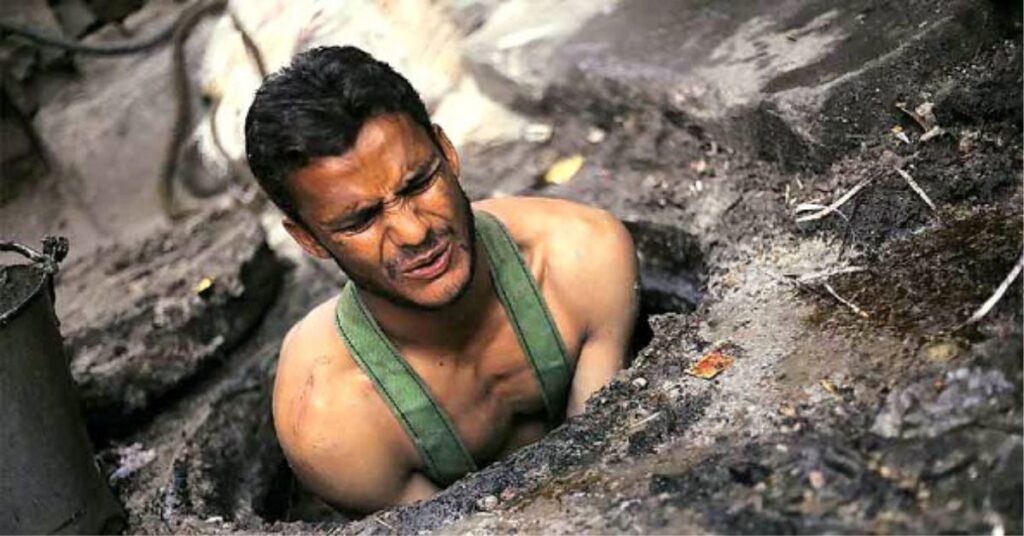
MANUAL SCAVENGING
In the era of the twenty-first century letting anyone to elevate human waste manually or allows him to enter into sewage without protecting gears leads to the degradation of human life and dignity as well. Even in 2025, numbers of sanitary workers lost their lives while entering sewage. On records, manual scavenging is prohibited but the irony is that it is still in practice. Meaning of Manual scavenging As per exception under THE PROHIBITION OF EMPLOYMENT AS MANUAL SCAVENGERS AND THEIR REHABILITATION ACT 2013 and THE EMPLOYMENT OF MANUAL SCAVENGERS AND CONSTRUCTION OF DRY LATRINES (PROHIBITION) ACT, 1993. – *If the person enters into a hazardous human excreta zone with protecting gears including oxygen cylinders shall not be deemed as manual scavenging. Difference between sanitary and unsanitary system Manual scavenging in rural areas. • Even after the seventy years of independence. Removal of human dry waste by bare hands still prevalent in India. Such practices still prevalent in Maharashtra, Uttar Pradesh, Assam, Bihar and Jammu and Kashmir. • Hereditary and caste factors are the main cause of practice. The maximum number of manual scavengers in rural areas are women. Men at the least. • They perform an act of removal of dry waste from farmlands and hut structure tent. • Include cleaning of bathrooms. • Causing social distance by associating them as untouchables. Manual scavenging in urban areas. • However supreme court in its judgment directs that ‘no person shall enter the sewer or septic tank without protecting gears. But unfortunately, sanitary works lost their lives due to toxic gas chambers of sewer and septic tanks. • Manual scavenging practices have been still performing in public toilets of metropolitan cities on daily basis. Legislation on Manual Scavenging 1. THE EMPLOYMENT OF MANUAL SCAVENGERS AND CONSTRUCTION OF DRY LATRINES (PROHIBITION) ACT, 1993 • This act is known as the first parent legislation to prohibit the removal of waste by human or for securing the dignity of human. This act is not in force in all territory of India. As per article 252 of the Indian constitution. Parliament made this act for the States of Andhra Pradesh, Goa, Karnataka, Maharashtra, Tripura and West Bengal and to all the Union territories. Any state can adopt this act. • Act prohibits any person to engage in or employ any person or permit to be engaged in manually carrying human excreta and construction or maintenance of a dry latrine. • Whoever fails to comply with provisions of this Act shall, in respect of each such failure or contravention be punishable with imprisonment for a term which may extend to one year or with fine, which may extend to two thousand rupees, or with both. 2. THE PROHIBITION OF EMPLOYMENT AS MANUAL SCAVENGERS AND THEIR REHABILITATION ACT, 2013 • This act was passed by the parliament enforce all over the territory of India except JAMMU AND KASHMIR. • This act prohibits any person, local authorities or any agency to construct an insanitary system and to employ any person indulging directly or indirectly as a manual scavenger. • Confers duty upon every individual and local authorities to demolish the insanitary system and to create a sanitary system. Even at their own cost. • Prohibits any kind of manual scavenging agreement as void. • Any person who breaches the above provisions of the act shall be liable for punishable with imprisonment for a term which may extend to one year or with fine which may extend to fifty thousand rupees or with both. In subsequent breach, person shall be liable for imprisonment which may extend to two years or with fine which may extend to one lakh rupees, or with both. • Offences are cognizable by district magistrate as well as judicial magistrate of first class. 3. REHABILITATION PROVISIONS OF THE ACT. • Within one month of application, the applicant has to submit photographs with details to claim benefits.its.conducted by them. Sanitary worker or scavengers have to apply by application to claim the benefits of this act. • Sanitary workers and scavengers can directly approach to them by application with joint annexure detailing about self. • Within one month of application, applicant have to submit photographs with details to claim benefits. • Applicants children entitled to state and central government scheme for education. • Applicant can avail the facility of concessional loan to engage in some other occupation rather than scavenging. • Applicants will get monthly benefits of three thousand for the next upcoming months for training. Supreme court judgment in manual scavenging [Safai Karamachari Andolan & Ors. Vs. Union of India & Ors. Writ Petition (Civil) 583/2003 ] • Sewer deaths –entering sewer lines without safety gears should be made a crime even in emergency situations. For each such death, compensation of Rs. 10 lakhs should be given to the family of the deceased. • Railways–should take time-bound strategy to end manual scavenging on the tracks. • Persons released from manual scavenging should not have to cross hurdles to receive what is their legitimate due under the law. • Provide support for dignified livelihood to safai karamchari women in accordance with their choice of livelihood schemes. • Court also said that rehabilitation must be based on the principles of justice and transformation. • The court also directed the Indian Railways, which is the largest employer of manual scavengers in the country, to take time bound strategy to end manual scavenging on the tracks. New Measures to prevent Manual Scavenging. • Under NDA government ‘swachh bharat abhiyan’ launched. Under the programme. Sanitary bathroom made at village level and promote to build a bathroom to avoid human excreta in opens. As well as to a huge extent. It avoids the practice of manual scavenging. • In metropolitan cities municipal corporation manage to regulate the sewage system. As well as metro corporation efforts to provide sanitary facilities at metro stations. Facts….. • Railway is the largest cause for manual scavenging in India. • Railway in India release ejects around