
Constitutional Law

Constitutional Law, family law, Matrimonial law

Supreme Court Guidelines regarding the Interim Maintenance Petitions under different Legislations in the matter of RAJNEESH v/s NEHA SC/0833/2020

In the last of 2020 in matter Rajneesh v/s NEHA SC/0833/2020, The judgment delivered by the Hon’ble supreme court regarding interim maintenance under the various provision of different laws relating to family law. In Rajneesh v/s NEHA SC/0833/2020, the supreme court formulated the guidelines relating to various issues faced by the family or magisterial court while ordering interim maintenance. However, guidelines issued by the supreme court is not so exhaustive in selective circumstances of the case where it appears before the court to dispense the order is must necessary. In this case the supreme court defined the scope or functions of provisions relating to maintenance. As well as summed up the dozens of previous case judgments to formulate guidelines. Generally while granting interim maintenance or final maintenance several issues are faced by the family or magisterial courts like Payment of interim maintenance, Issue of Overlapping Jurisdictions under different maintenance provision under a different statute, Criteria for determining the quantum of maintenance, Date from which Maintenance to be awarded and Enforcement of orders of maintenance. The various opinion of the high court made the functioning of provisions critical. Facts of the case…Criminal appeal filed  by the applicant husband Against the interim order of a magisterial court under section 125 crpc to pay interim maintenance to his wife and minor son. Courts across nation including High courts were clueless pertaining to uniformity and consistency while deciding the interim maintenance  Supreme court in this judgment stated it is necessary to frame guidelines to ensure that there are uniformity and consistency in deciding the interim maintenance within time to ensure the very intention of the legislation to assist the women. Supreme Court Guidelines…… A. issue of Overlapping Jurisdiction• petitioner can seek maintenance under various laws including interim maintenance under Hindu marriage act, CRPC, Hindu Adoption and Maintenance Act. and compensation under The Domestic Violence Act.• Parties not precluded from claiming maintenance under various laws at a time. But have to disclose the various prior maintenance petition pending before courts with the details of the application in which there is a need to enhance the amount of maintenance.• Section 37 of the Special Marriage Act provides for the grant of permanent alimony at the time of passing of the decree. Supreme courts holds that section 37 is also the same religion-neutral provision likewise section 125 crpc. Even registration of marriage of two different religion person not mandatory to seek maintenance under this provision. The intent of the legislation to sum up the uniform maintenance law irrespective of their religion. Not gender-neutral, only wife entitled to claim maintenance. • Section 24 of the Hindu marriage act provides for maintenance pendente lite, where the Court may direct the Respondent to pay the expenses of the proceeding, and pay such reasonable monthly amount, which is considered to be reasonable, having regard to the income of both the parties. This provision is not religion-neutral. Only applicable to Hindu spouse belonging Hindu, Sikh, Bodh, Jain only. This provision is gender-neutral. Under section 24 even husband can claim maintenance if he’s not sufficient to maintain himself. Section 24 confers the right upon the wife as well as upon the husband to claim interim maintenance. • Section 18 of HMA ‘’’a Hindu wife, whether married before or after the commencement of this Act, shall be entitled to be maintained by her husband during her lifetime. (2) A Hindu wife shall be entitled to live separately from her husband without forfeiting her claim to maintenance. This provision is not gender or religion-neutral. Also confers the right upon the wife to claim maintenance as similar to section 25 of Hindu marriage act. But the only difference between both the provision is that, to claim maintenance under section 18 of HAMA wife not need to live separate or to get a divorce decree. Wife can claim maintenance even sharing a household with her husband. On the other hand, the wife can claim maintenance only when she filed an application to get divorced under Hindu marriage act. • Section 19 of the HAMA provides that a widowed daughter-in-law may claim maintenance from her father-in-law if (i) she is unable to maintain herself out of her own earnings or other property; or, (ii) where she has no property of her own, is unable to obtain maintenance; (a) from the estate of her husband, or her father or mother, or (b) from her son or daughter, if any, or his or her estate. • The D.V. Act provides relief to an aggrieved woman who is subjected to “domestic violence.” The “aggrieved person” has been defined by Section 2(a) to mean any woman who is, or has been, in a domestic relationship with the Respondent, and alleges to have been subjected to any act of domestic violence. Section 2(f) defines” domestic relationship” to include a relationship between two persons who live, or have at any point of time lived together in a shared household, when they are related by consanguinity, marriage, or through a relationship in the nature of marriage, adoption, or are family members living together as a joint family. A three-judge bench of this Court in Satish Chander Ahuja v. Sneha Ahuja 2020. wherein a two judge bench held that the wife is entitled to claim a right of residence in a “shared household” Under Section 17 (1), which would only mean the house belonging to, or taken on rent by the husband, or the house which belongs to the joint family of which the husband is a member. At any time taken on rent does not include continuous shifting home. Wife can only claim right to residence irrespective of the ownership of the husband. But the important fact that the spouse lived together at such place for a much time. DV ACT is gender neutral act under which women can claim compensation for the domestic violence inflicted upon herself by the other women. However, not all live-in relationships would amount to a relationship in the
Constitutional Law, Human Rights

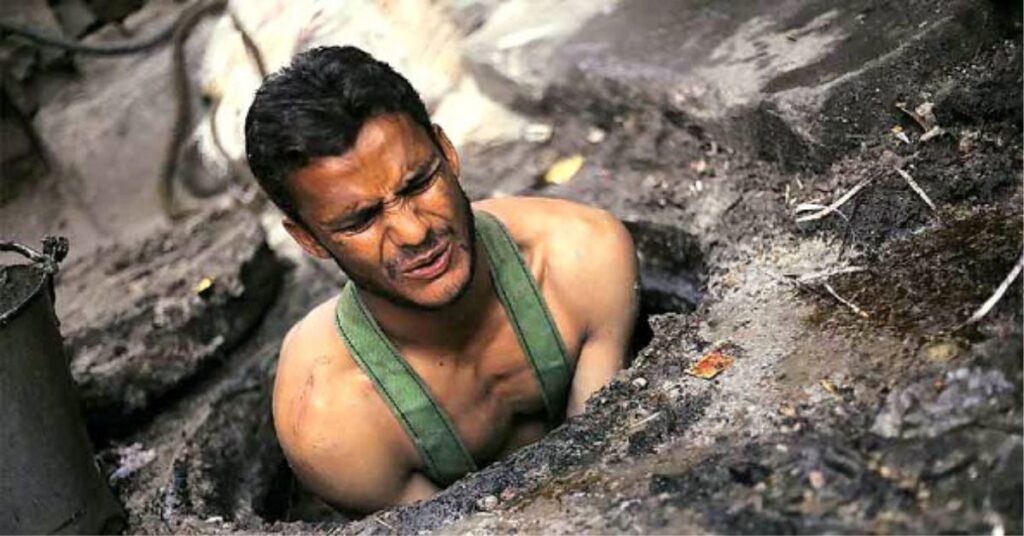
MANUAL SCAVENGING

In the era of the twenty-first century letting anyone to elevate human waste manually or allows him to enter into sewage without protecting gears leads to the degradation of human life and dignity as well. Even in 2025, numbers of sanitary workers lost their lives while entering sewage. On records, manual scavenging is prohibited but the irony is that it is still in practice. Meaning of Manual scavenging As per exception under THE PROHIBITION OF EMPLOYMENT AS MANUAL SCAVENGERS AND THEIR REHABILITATION ACT 2013 and THE EMPLOYMENT OF MANUAL SCAVENGERS AND CONSTRUCTION OF DRY LATRINES (PROHIBITION) ACT, 1993. – *If the person enters into a hazardous human excreta zone with protecting gears including oxygen cylinders shall not be deemed as manual scavenging. Difference between sanitary and unsanitary system Manual scavenging in rural areas. • Even after the seventy years of independence. Removal of human dry waste by bare hands still prevalent in India. Such practices still prevalent in Maharashtra, Uttar Pradesh, Assam, Bihar and Jammu and Kashmir.  • Hereditary and caste factors are the main cause of practice. The maximum number of manual scavengers in rural areas are women. Men at the least. • They perform an act of removal of dry waste from farmlands and hut structure tent. • Include cleaning of bathrooms. • Causing social distance by associating them as untouchables. Manual scavenging in urban areas. • However supreme court in its judgment directs that ‘no person shall enter the sewer or septic tank without protecting gears. But unfortunately, sanitary works lost their lives due to toxic gas chambers of sewer and septic tanks. • Manual scavenging practices have been still performing in public toilets of metropolitan cities on daily basis. Legislation on Manual Scavenging 1. THE EMPLOYMENT OF MANUAL SCAVENGERS AND CONSTRUCTION OF DRY LATRINES (PROHIBITION) ACT, 1993 • This act is known as the first parent legislation to prohibit the removal of waste by human or for securing the dignity of human. This act is not in force in all territory of India. As per article 252 of the Indian constitution. Parliament made this act for the States of Andhra Pradesh, Goa, Karnataka, Maharashtra, Tripura and West Bengal and to all the Union territories. Any state can adopt this act. • Act prohibits any person to engage in or employ any person or permit to be engaged in manually carrying human excreta and construction or maintenance of a dry latrine. • Whoever fails to comply with provisions of this Act shall, in respect of each such failure or contravention be punishable with imprisonment for a term which may extend to one year or with fine, which may extend to two thousand rupees, or with both. 2. THE PROHIBITION OF EMPLOYMENT AS MANUAL SCAVENGERS AND THEIR REHABILITATION ACT, 2013 • This act was passed by the parliament enforce all over the territory of India except JAMMU AND KASHMIR. • This act prohibits any person, local authorities or any agency to construct an insanitary system and to employ any person indulging directly or indirectly as a manual scavenger. • Confers duty upon every individual and local authorities to demolish the insanitary system and to create a sanitary system. Even at their own cost. • Prohibits any kind of manual scavenging agreement as void. • Any person who breaches the above provisions of the act shall be liable for punishable with imprisonment for a term which may extend to one year or with fine which may extend to fifty thousand rupees or with both. In subsequent breach, person shall be liable for imprisonment which may extend to two years or with fine which may extend to one lakh rupees, or with both. • Offences are cognizable by district magistrate as well as judicial magistrate of first class. 3. REHABILITATION PROVISIONS OF THE ACT. • Within one month of application, the applicant has to submit photographs with details to claim benefits.its.conducted by them. Sanitary worker or scavengers have to apply by application to claim the benefits of this act. • Sanitary workers and scavengers can directly approach to them by application with joint annexure detailing about self. • Within one month of application, applicant have to submit photographs with details to claim benefits. • Applicants children entitled to state and central government scheme for education. • Applicant can avail the facility of concessional loan to engage in some other occupation rather than scavenging. • Applicants will get monthly benefits of three thousand for the next upcoming months for training. Supreme court judgment in manual scavenging [Safai Karamachari Andolan & Ors. Vs. Union of India & Ors. Writ Petition (Civil) 583/2003 ] •  Sewer deaths –entering sewer lines without safety gears should be made a crime even in emergency situations. For each such death, compensation of Rs. 10 lakhs should be given to the family of the deceased. •  Railways–should take time-bound strategy to end manual scavenging on the tracks. •  Persons released from manual scavenging should not have to cross hurdles to receive what is their legitimate due under the law. • Provide support for dignified livelihood to safai karamchari women in accordance with their choice of livelihood schemes. • Court also said that rehabilitation must be based on the principles of justice and transformation. •  The court also directed the Indian Railways, which is the largest employer of manual scavengers in the country, to take time bound strategy to end manual scavenging on the tracks. New Measures to prevent Manual Scavenging. • Under NDA government ‘swachh bharat abhiyan’ launched. Under the programme. Sanitary bathroom made at village level and promote to build a bathroom to avoid human excreta in opens. As well as to a huge extent. It avoids the practice of manual scavenging. • In metropolitan cities municipal corporation manage to regulate the sewage system. As well as metro corporation efforts to provide sanitary facilities at metro stations. Facts….. • Railway is the largest cause for manual scavenging in India. • Railway in India release ejects around

green and white braille typewriter
Constitutional Law, Dynamic Injunction, Intellectual Property Rights, John Doe Orders, Temporary Injunction

PERVIEW OF COPYRIGHT ACT AND ITS INFRINGEMENT

Copyright is one of the branches of Intellectual Property Rights accepted universally after the TRIPS [Trade-Related Aspects of Intellectual Property Rights ] agreement 1994. Its rules and regulations controlled and formulated by world Intellectual Property Organisation. MEANING OF COPYRIGHT.. [ HEREINAFTER MENTIONED AS C.R ] C.R based on the concept of the original creation of the work in the field of artistic, literary, cinematography, software programming, photographic works etc. It also includes the alteration work of the copyright registered work, validate under the purview of ‘flavour of the creativity doctrine’. These are the subject matters of CR (a) original literary, dramatic, musical and artistic works; (b) cinematograph films (c) sound recording [d] software programme [e] photographic work [f] designs, graphs and maps. Example music created by the composer, he is the creator also having the right to get a copyright for his work. Same it is applicable to director of movie and authors of a novel etc. CR holders have certain rights to do with their copyright work like reproduction, assignment, licensing, perform, transfer, store, communicate and commercial activity. INFRINGEMENT OF COPYRIGHT … According to section 51 of CR Act, these acts amount to infringement of CR 1. Unauthorised and illegal reproduction of the CR work deemed to be infringement. Here ‘unauthorised’ means to reproduce work without the prior assignment of the work to the offender. 2. Does any act which against the agreement/ assignment conditions. 3. Performance, telecast, publications without consent of the CR holder. 4. Distribution for commercial purposes and personal benefits.These actions will not amount to infringement, if the creator of CR work assigns his work to any person with the compliance of sections 18 and 19 of the act. Here are some conditions prescribed under these provisions… 1. Assignment of work can be done for partial work or for a whole. 2. Present work or the work to be done [ future] can also be assign. 3. Express [ written ] assignment/agreement is mandatory 4. Agreement shall contain the clause like the identity of work [ type], rights transferred [ specific], duration of the assignment, territorial extent and payable amount of royalty. 5. In the case where the duration of assignment of the work not specified, it shall be deemed for a five-year duration. 6. If any of the rights transferred by assignment to the assignee not exercised by him within a year, it shall be deemed to expire, lapse or waiver. Above mention process of assignment of the work protect a person from prosecution of CR infringement. But there are also certain ways to use the copyright work for the benefits work with balancing creator rights. These acts however inspired by the copyright work but not amount to its infringement…. There is a general principle that copyright cannot be available for the idea and for the work related to natural resources, historical events, facts certain or obvious to everyone. This principle accepted universally. guidelines by the honourable supreme court in RG ANAND V/S DELUX FILMS AIR 1978 SC 1613. A person can apply for copyright for its work inspired by a certain idea but can’t copyright the ‘IDEA’, because if we copyright ideas it will lead to violation of our fundamental right of ‘speech and expression’. The term Expression includes data. Ideas and information. This principle got light in the case of STAR INDIA [ PVT. LTD.] V/S LEO BURNETT PVT.LTD.2 003 (2) Bom. CR 655. The facts of this case were.. 1. ‘kyunki saas bhi kabhi bahu thi’ serial made and telecast by balaji films. Later on tide detergent advertisement was published with the slogan ‘BAHU BHI KABHI SAAS BANEGI’ inferencing the same as the characters of the serial. 2. Bombay high court held that there is no copyright in the dialogue because it is the creation of an idea and must not be a monopoly over it by the creator. Idea is not a matter of copyright violation. Thus no one can claim over it. • Doctrine of ‘flavour of creativity’ 1. This is an American doctrine, according to this doctrine a person can create his own work inspired by the existing copyright work with certain due diligence. This doctrine imported from American precedent in the EBC law publisher case. If the subsequent work is different from the original one but certain efforts, value, mind, changes and due diligence must be invested in it. It cannot be just copied and paste from prior work. Availability of Prior work does not matter. It could be from the public domain or the private domain as well.2. IN EBC AND ORS, V/S DB MODAK AND ANR. AIR 2008 SC. SCC Legal sued EBC LEGAL PUBLISHER for copying his short notes, footnote and citations from scc online. 3. Court held that it would not amount to infringement of the copyright. The important fact is that the work of both the parties were also not his own creation. The judgement pronounced in court is the creation of the judge own mind. However, it is available in public domain. A person can elaborate and mention thereto by applying his mind, time, efforts, due diligence and hard work. If the subsequent work different from the existing one not just an example of copy-paste. It would protect the creator of subsequent work from copyright infringement prosecution. creativity must to be followed. • DOCTRINE OF FAIR USE OR FAIR DEALING1. According to this doctrine, a person can enjoy the work of prior copyright work for its mental and societal benefits. But it should not be for commercial or trade purposes.2. This doctrine powered/penned down in section 52 of the act. Person can enjoy copyright work for personal use for the research and analysis, for educational purpose, for criticism, for library not more than three copies. But it should not be for commercial purposes to gain benefits otherwise it will lead to infringement of copyright work.3. Doctrine elaborated in the case of CHANCELLOR MASTERS AND SCHOLARS OF UNIVERSITY OF OXFORD V/S NARENDRA

Scroll to Top